
You found the unit. The association has insurance on the building. So your own policy is a formality — that’s what almost every condo buyer assumes, and it’s where the trouble starts.
The master policy does cover the building, up to a point that varies enormously from one association to the next. Everything past that point is yours. On the Grand Strand, where a large share of coastal property is condo, that gap is the single most misunderstood thing in the market.
We write condo coverage across Myrtle Beach, North Myrtle Beach, Cherry Grove, and the Charleston area, including units owners rent out.
The Master Policy Decides What Your Policy Has To Do
Association master policies come in three broad forms, and which one your building carries changes your exposure completely.
Bare walls. The association covers the structure, common areas, and not much inside your unit. Drywall inward is yours — flooring, cabinets, fixtures, appliances, interior walls. This is the widest gap and it is common in older buildings.
Single entity. The association covers original construction and fixtures as installed. Upgrades you or a previous owner made are yours. If the unit was renovated after it was built, the difference between original and current is your responsibility.
All-in. The association covers the unit including fixtures and improvements. Your policy still handles personal property, liability, loss of use, and loss assessment — but the interior gap narrows considerably.
You cannot know what your HO-6 needs to do until you know which of these your association carries. Get the master policy declarations page. Any association will provide it, and it is worth reading before you set your limits.
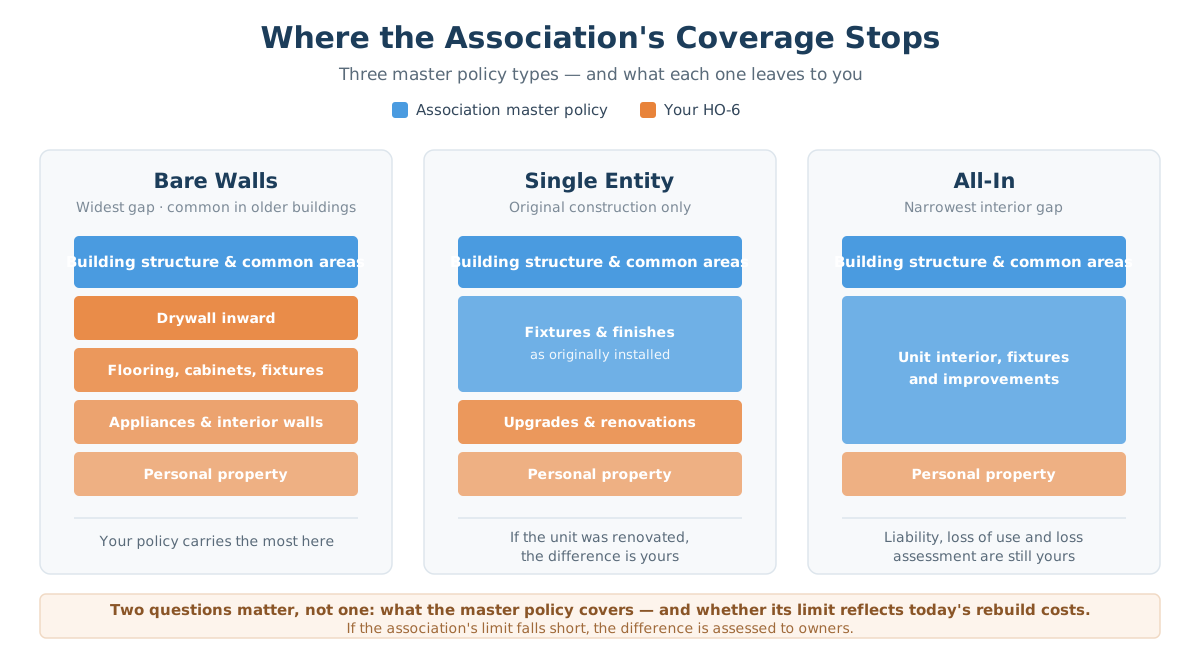
The Question Almost Nobody Asks — Is the Master Policy Even Enough?
There are two different ways an association’s insurance can leave you holding a bill, and buyers usually only hear about the first one.
The first is scope. Where the master policy stops and yours begins — the bare walls, single entity, and all-in distinction above. That’s the question most people eventually ask.
The second is limit. Whether the association’s coverage is large enough to actually rebuild the building. And in our experience reviewing master policies along the coast, this is the more common problem: many of the master policies we see are significantly underinsured relative to what the building would cost to rebuild today.
Construction costs have risen sharply over the past several years. Master policy limits frequently have not kept pace. An association that insured its building appropriately five years ago may now be carrying a limit well below current replacement cost — and because nothing about the policy looks wrong on paper, nobody notices.
Until there’s a claim.
So the question worth asking before you buy: if the master policy falls short, who pays the difference?
You do. Along with every other owner in the building.
Loss Assessment — The Coverage That Absorbs That Bill
When a loss exceeds what the association’s policy will pay, the association can assess owners for the shortfall. Your share arrives as a bill, and it is not optional.
Loss assessment coverage on your own policy can respond to that bill. It may also respond when the association’s deductible is passed through to owners — which on a coastal building with a percentage-based wind deductible can be a significant number on its own, entirely separate from any coverage shortfall.
Whether it responds, and how much it pays, depends on the specifics. The cause of the loss, your policy’s wording, how the assessment is characterized, and whether it arises from covered property or liability damage all matter. Named-storm and flood assessments deserve particular attention — some policies limit or exclude assessment coverage arising from those perils. Loss assessment is a valuable coverage, but it is not a blanket reimbursement for every charge an association issues.
Standard HO-6 policies include a modest loss assessment limit by default. Often a few thousand dollars. Against a coastal building that is both underinsured and carrying a percentage wind deductible, that default limit is not built for the exposure it’s being asked to absorb.
This is the limit we most often recommend increasing on Grand Strand and Charleston-area condos. Relative to what it protects against, it is one of the least expensive changes you can make to a condo policy.
What to Ask For Before You Close
Three documents answer nearly everything:
The master policy declarations page. Identifies which type of master policy is in force — bare walls, single entity, or all-in — and therefore what your HO-6 has to cover.
The master policy limit, against the building’s current replacement cost. This is the question that gets skipped. A limit set years ago against today’s construction costs is where the exposure hides.
The association’s deductible structure. Particularly the named-storm deductible, and whether it is passed through to owners.
Any association will provide the first. The second and third take a direct question, and they are worth asking before you’re committed rather than after.
Bring all three to a policy review and we will tell you exactly what your own policy needs to do.
What Else Your Condo Policy Handles
Personal property. Furniture, electronics, clothing, and everything else you own inside the unit. On a rental unit, this includes the furnishings you provide.
Interior improvements and betterments. Renovations, upgraded flooring, updated kitchens and baths — whatever exceeds original construction under a single entity or bare walls master policy.
Liability. Injuries occurring inside your unit. If you rent short-term, standard liability is generally not sufficient — a paying guest is not a social guest.
Loss of use. If the unit becomes uninhabitable, this covers your additional living costs. On a rental unit, the parallel coverage is loss of rental income, which is separate.
Wind and named-storm deductible. Your deductible is typically percentage-based and calculated on your dwelling limit. Worth knowing as a dollar figure before hurricane season.
→ Wind mitigation discounts in South Carolina
Flood, separately. Condo owners frequently assume upper-floor units have no flood exposure. Flood affects the building, common areas, mechanical systems, and the association’s ability to operate — and lender requirements apply regardless of floor.
→ Flood and hurricane coverage
If You Rent Your Condo
A standard HO-6 assumes you occupy the unit. Renting changes the occupancy, and occupancy is what carriers underwrite.
Long-term tenant requires a policy written for rental use, with liability reflecting a tenant in residence and coverage for lost rental income.
→ Renting out your coastal property
Short-term rental through Airbnb or VRBO requires coverage built for guest occupancy — commercial general liability, loss of fair rental value, and explicit permission for high turnover. Most standard policies exclude it outright.
→ Renting your coastal property on Airbnb or VRBO
Platform protection programs are one layer, subject to their own terms and limited to bookings made through that platform. They do not replace a policy written for guest occupancy.
Check the association’s rules as well. Many Grand Strand buildings restrict or prohibit short-term rental, and a policy will not fix a covenant violation.
Frequently Asked Questions
Doesn’t the association’s insurance cover everything?
No. The master policy covers the building to a defined point, and that point varies by association. Bare walls policies leave everything from drywall inward to you. Even all-in policies leave personal property, liability, loss of use, and loss assessment.
What is loss assessment coverage and how much do I need?
It can cover your share when the association assesses owners after a loss exceeds its coverage or applies its deductible. Whether it responds depends on the cause of loss and your policy’s wording — named-storm and flood assessments are treated differently by different policies. Default limits on standard policies are frequently low relative to coastal exposure, particularly where the master policy limit hasn’t kept pace with rising construction costs. The right limit depends on your building’s master policy and deductible structure.
Do I need flood insurance for a third-floor condo?
Possibly. Flood affects the building, common areas, and mechanical systems regardless of your floor, and lender requirements are based on the building’s flood zone rather than your unit’s elevation. It is worth a specific answer for your building.
Can I insure a condo I rent on Airbnb?
Yes, with the right policy. A standard HO-6 assumes owner occupancy and generally excludes short-term rental. Coverage built for guest occupancy exists. Check your association’s rules first — many coastal buildings restrict it.
Why did my condo premium increase when nothing changed?
Coastal condo rates are driven by building-level factors — the association’s claims history, reinsurance costs, and rebuilding costs across the Southeast. Your unit’s own history is only part of the picture.
How do I find out what my master policy covers?
Request the declarations page from your association or management company. It identifies which type of master policy is in force. Bring it to a policy review and we’ll tell you exactly what your HO-6 has to cover.
We Review These Documents Every Week
Coastal Insurance Brokers is an independent agency with offices in Mount Pleasant and North Myrtle Beach. We place coastal condo coverage across the Charleston area and the Grand Strand, and we read association master policies as part of that work.
John Cosgrove, Owner & Principal Insurance Advisor
Licensed South Carolina Property & Casualty Agent, License #446274
South Carolina Surplus Lines Broker
→ Meet our licensed agents
Reviewed August 1, 2026 · Serving coastal South Carolina
Part of our guide to owning coastal property in South Carolina.
Is Your Building Underinsured? Find Out Before You Close.
Send us the association’s master policy declarations page and we’ll tell you three things: which type of master policy is in force, whether the limit reflects what the building would actually cost to rebuild today, and what your own policy needs to cover as a result.
No cost, no obligation. If everything checks out, you’ll know — and that’s worth knowing.
Call (843) 471-2621 · Text (843) 834-6408