
If you rent a beach house or condo on Airbnb or VRBO, your homeowners policy probably does not cover it.
That is not a technicality. It is the single most common coverage gap we find on coastal South Carolina rental properties, and owners usually discover it at the worst possible moment — after a claim, when the carrier asks how the property was being used.
We place short-term rental coverage across the Grand Strand and the Charleston area, including North Myrtle Beach, Myrtle Beach, Mount Pleasant, Isle of Palms, and Folly Beach.
For details specific to Myrtle Beach and North Myrtle Beach — including local zoning and business-license rules for short-term rentals — see our Myrtle Beach short-term rental insurance guide.
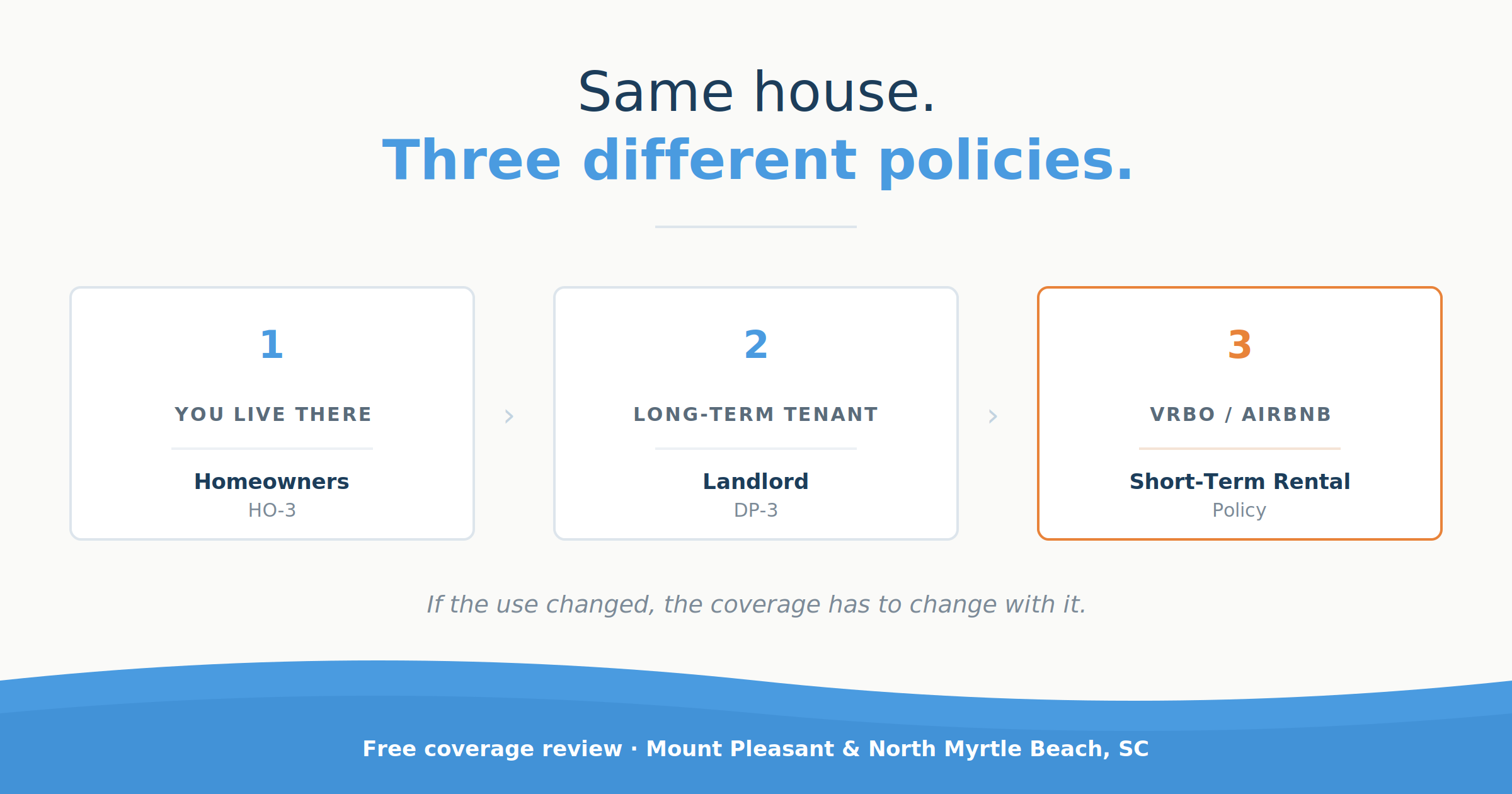
Same House. Three Different Policies.
How a property is used determines which policy it needs. The building doesn’t change. The coverage does.
You live there — Homeowners (HO-3). A standard homeowners policy assumes the property is your residence. It is priced and underwritten on that basis.
Long-term tenant — Landlord (DP-3). A dwelling policy built for rental use: premises liability, lost rental income, and coverage that reflects a tenant occupying the home. Your tenant carries their own renters insurance for their belongings.
→ Renting out your coastal property long-term
Airbnb or VRBO — Short-term rental policy. Most standard policies exclude short-term hosting outright. Platform protections are a backstop, not a policy. Purpose-built short-term rental coverage exists, and we place it.
If your home’s use has changed and your coverage hasn’t, that gap is already open.
What Platform Protection Does and Doesn’t Do
Airbnb and VRBO both offer host protection programs, and owners frequently assume they’re covered. The programs are real and can be valuable — but it’s worth understanding what each part actually is.
Airbnb’s AirCover for Hosts has two distinct components. Host Damage Protection is described by Airbnb as not an insurance policy, and Airbnb states it does not cover normal wear and tear or acts of nature such as hurricanes. Host Liability Insurance is separate, is insurance, and is subject to its own terms, conditions, and exclusions.
VRBO provides a liability program and offers guest-purchased damage protection. VRBO’s own guidance recommends a comprehensive vacation rental policy for the building, contents, income, and liability, and notes that an occasional-rental endorsement may be inadequate for a property rented regularly.
The practical point: platform programs are one layer, tied to bookings made through that platform and governed by that program’s terms. They are not a substitute for a policy covering the building, wind, flood, business income, off-platform bookings, or year-round premises liability. If you take direct bookings, or rent through more than one platform, the gaps widen.
Program terms change. Confirm current coverage directly with the platform.
What a Coastal Short-Term Rental Policy Should Include
Commercial general liability. A paying guest is not a social guest. If someone is injured on the stairs, at the pool, in a hot tub, or on a dock, you need liability coverage written for commercial occupancy.
Loss of fair rental value. If a named storm takes the property offline during peak season, this replaces the booking revenue you lose while it’s repaired. On a Grand Strand property, a summer outage is the difference between a bad year and a manageable one.
No occupancy restrictions. This is the one most often missed. Some landlord policies contain language that lets a carrier deny a claim when a property sees high guest turnover. The policy has to explicitly permit short-term occupancy — not merely fail to prohibit it.
Wind and named-storm coverage. Coastal wind deductibles are percentage-based, calculated on the insured value rather than a flat dollar amount. On a higher-value rental this is a substantial number, and it is worth knowing before hurricane season rather than during it.
→ Wind mitigation discounts in South Carolina
Flood, separately. Property policies do not cover flood. On the Grand Strand and in the Charleston area this is a live question, not a formality.
→ Flood and hurricane coverage
Contents and furnishings. A furnished rental carries far more owner-owned contents than an ordinary rental. Standard limits are frequently too low.
Not All Short-Term Rentals Are Underwritten the Same
Carriers care about how the property is used, not just that it’s rented.
A home you occupy most of the year and rent a few weeks each summer is a different risk than a property rented forty weeks a year and managed remotely. Owner-occupied with occasional rental, seasonal rental, and full-time investment rental sit in three different underwriting categories — and carriers that will write one may decline another.
Other factors that determine eligibility on the coast:
- Distance to the ocean
- Construction type and roof age
- Prior claims on the property
- Whether it’s a condo or a detached home
- Pool, hot tub, dock, or elevator on the property
- Whether a local property manager is in place
Which Carriers Write This — And Why It Varies So Much
Two properties on the same street, with the same square footage and the same rental history, can get very different answers from the same carrier. What drives it isn’t the house. It’s how each carrier’s rating plan weights the specific combination of factors in front of it.
The factors that move the needle most on the Grand Strand:
Rental frequency and pattern. Owner-occupied with occasional summer rental, seasonal rental, and full-time investment rental sit in three separate underwriting categories. A carrier comfortable with one may decline another outright.
Distance to water. Not a single threshold — carriers draw the line in different places, and some distinguish oceanfront from ocean-view from second-row.
Roof age and construction. The most common single reason a coastal rental gets declined.
Prior claims on the property. Claims follow the address, not the owner. A property with recent claims history is a different risk to a new buyer than the listing suggests.
Condo versus detached. Different products, different markets, and association rules layered on top.
→ Buying a coastal South Carolina condo
Whether a local property manager is in place. Increasingly relevant, and likely to become more so if North Myrtle Beach adopts a local responsible party requirement.
When standard markets decline, surplus lines carriers write this business. That access is the practical reason to work with an independent agency rather than a single-carrier agent — a captive agent has one answer, and on a coastal rental it is frequently no.
What North Myrtle Beach Requires
First, confirm the property is actually in the city. North Myrtle Beach mailing addresses extend beyond the municipal boundary, and properties in unincorporated Horry County fall under county business license and hospitality fee requirements instead. The parcel address settles it, and it changes which rules apply.
For properties inside city limits, the City of North Myrtle Beach requires short-term rentals to:
- Obtain a city business license
- Collect and remit rental accommodations tax to the city, county, and state
- Renew licenses annually and keep license information current
The city notes that it actively monitors rental activity to confirm properties are properly licensed, and asks operators to screen guests, follow local laws, and respond promptly when issues arise.
The rules are under active review. The city has held a series of public sessions on short-term rental regulation — council workshops in November 2024 and January 2025, and a June 2025 information-gathering session attended by more than 200 residents. Proposals discussed have included a Responsible Local Agent requirement: a designated agent living within 30 miles of North Myrtle Beach, operating under a city business license, able to respond in person to issues at the property.
That proposal matters most if you don’t live here. If you’re buying from out of state and planning to self-manage remotely, a local agent requirement would change how you operate. Nothing discussed at a workshop is law until it’s adopted — but it is worth knowing what’s being considered before you buy.
North Myrtle Beach and Myrtle Beach are separate municipalities with separate ordinances, and their approaches to short-term rental regulation differ. Requirements in one do not carry over to the other, and buyers routinely conflate the two. If you’re buying with rental income in mind, verify the current local requirements for that specific property — city, jurisdiction, and zoning — before you make an offer, not after.
Last Verified: August 1, 2026 · Source: City of North Myrtle Beach, Short-term Rentals (nmb.us/833)
This summary applies to properties inside North Myrtle Beach city limits. Local requirements change, and the city has been actively reviewing its short-term rental rules. Confirm current requirements with the City of North Myrtle Beach before relying on this — or send us the address and we’ll confirm which jurisdiction applies. Insurance and legal operating authority are separate matters; a policy does not make a rental compliant.
Buying a Property You Plan to Rent
If you’re buying with rental income in mind, insurance belongs in your due diligence — not your closing checklist.
Get a quote based on the intended use, not the current use. A property insured as a seller’s second home may be uninsurable, or priced very differently, as a full-time short-term rental. Roof age, distance to water, and prior claims can all limit which carriers will write it, and finding that out after you’re under contract narrows your options considerably.
We quote properties before purchase. It costs nothing and it occasionally changes what someone is willing to offer.
→ Buying a beach house in South Carolina
Frequently Asked Questions
Does my homeowners policy cover Airbnb guests?
Usually not. Most homeowners policies exclude or sharply limit coverage once a property is rented to paying guests. Some carriers offer an endorsement for occasional rental; many do not. The determining factor is disclosure — rental activity has to be disclosed before the policy is written, not after a claim.
Is Airbnb’s host protection enough on its own?
Not on its own. AirCover includes Host Damage Protection — which Airbnb states is not an insurance policy and does not cover acts of nature such as hurricanes — and a separate Host Liability Insurance program subject to its own terms. Both are limited to bookings through the platform. Treat them as a layer behind a policy written for rental use, not as the policy itself.
What if I only rent a few weeks a year?
It still needs disclosure. Some carriers will write occasional rental on an endorsement; others treat any short-term rental as a change in occupancy. The frequency matters to underwriting, but the disclosure is not optional either way.
Do I need a separate policy for a condo?
Usually yes. The association’s master policy covers the building to a defined point, and your HO-6 covers from there in — plus contents, liability, and loss assessment. Renting short-term changes what your side of that line needs to look like.
Can I get coverage if my property is oceanfront?
Often, though it depends on distance to water, construction, roof age, and claims history. Some placements move to surplus lines markets. This is where working with an independent agency matters — a single-carrier agent has one answer, and it may be no.
What happens to my rental income if a hurricane hits?
Only if you carry loss of fair rental value. It covers lost booking revenue while the property is uninhabitable. On a seasonal Grand Strand rental this is one of the most valuable coverages on the policy and one of the most frequently omitted.
We Place This Business
Coastal Insurance Brokers is an independent agency with offices in Mount Pleasant and North Myrtle Beach. We compare carriers across the standard, high-value, and surplus lines markets, including markets most local agencies cannot access directly.
Short-term rental placements on the coast get declined by carriers that write the same house happily as an owner-occupied home. Knowing which markets want this business — and which have pulled back — is the difference between a policy and a runaround.
John Cosgrove, Owner & Principal Insurance Advisor
Licensed South Carolina Property & Casualty Agent, License #446274
South Carolina Surplus Lines Broker
→ Meet our licensed agents
Reviewed August 1, 2026 · Serving coastal South Carolina
Part of our guide to owning coastal property in South Carolina.
Renting It Out? Let’s Make Sure the Policy Knows That.
Send us your current policy and tell us how you actually rent the property — occasionally, seasonally, or full-time. We’ll tell you whether your coverage matches the use, where the gaps are, and which markets write this business on the Grand Strand.
No cost, no obligation.
Call (843) 471-2621 · Text (843) 834-6408