
If you’re buying on the South Carolina coast from another state, insurance is not a closing formality. It is a due diligence item, and occasionally it changes the deal.
Buyers from outside the state are frequently surprised by three things: what coastal coverage costs, that flood is a separate policy, and that some properties are difficult to insure at all through standard carriers. None of that is obvious from the listing.
We work with buyers before closing across Charleston, Mount Pleasant, and the Grand Strand, including buyers who have never owned property in South Carolina.
Ask Whether It’s Insurable Before You Ask What It Costs
Standard carriers decline coastal properties for reasons that have nothing to do with the buyer: roof age, distance to water, prior claims on the property, construction type, and the age of electrical, plumbing, and HVAC systems.
A property the seller has insured for years may be a different proposition for you. Their policy reflects their claims history, their carrier relationship, and often a rate locked in before the market tightened. You cannot assume a seller’s policy — you are buying a house, not a policy.
Get an insurability answer during due diligence. It is free, it takes very little time, and it occasionally affects what a buyer is willing to offer.
The Coverages a Coastal Property Needs
Homeowners. Dwelling, contents, liability, and additional living expense.
Wind and named storm. Depending on carrier and location, wind may carry a separate percentage-based deductible calculated on the insured value rather than a flat dollar amount. On a higher-value coastal home this is a significant number and should be understood before closing.
Flood — separate policy, always. Homeowners insurance does not cover flood. Properties outside high-risk zones still flood from heavy rain, storm surge, and tidal events. If you’re financing and the property sits in a high-risk zone, your lender will require it.
→ Flood and hurricane coverage
Umbrella liability. Common for coastal owners, particularly with pools, docks, or rental use.
Short-term rental coverage, if applicable. If you plan to rent through Airbnb or VRBO, that must be disclosed before the policy is written, not after.
→ Renting your coastal property on Airbnb or VRBO
If you’re buying a condo, the association’s master policy determines what your own policy has to cover — and that varies enormously by building.
→ Buying a coastal South Carolina condo
The Documents That Determine Your Rate
Elevation certificate. Documents the property’s elevation relative to base flood elevation. Frequently the difference between an affordable flood premium and an expensive one. Ask the seller whether one exists — many coastal properties already have one.
Wind mitigation inspection. Documents roof-to-wall connections, roof deck attachment, opening protection, and roof covering. Credits only apply if the features are documented and filed with the carrier.
→ Wind mitigation discounts in South Carolina
4-point inspection. Roof, electrical, plumbing, HVAC. Commonly required on older properties and determines which carriers will consider the risk at all.
Flood zone determination. Establishes whether your lender requires flood coverage. Zones vary lot by lot on the coast — sometimes street to street.
The Timeline
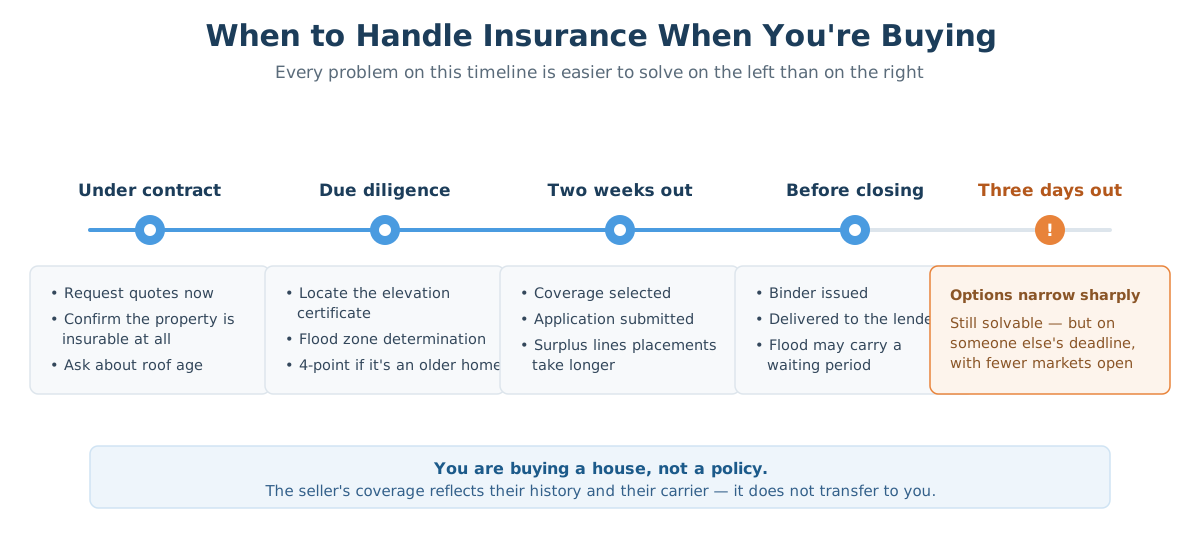
Under contract. Request insurance quotes now, not at closing. This is when problems are still solvable.
During due diligence. Insurability confirmed, elevation certificate located or ordered, inspections completed. If the property is hard to place, this is when you learn it.
Two weeks out. Coverage selected, application submitted, underwriting review. Surplus lines placements take longer than standard.
Before closing. Binder issued and delivered to your lender. Most lenders require proof of coverage several days ahead of closing, and flood coverage may carry a waiting period.
The most common problem we see is a buyer who requested a quote three days before closing on a property no standard carrier will write.
Buying From Another State
You do not need to be a South Carolina resident to insure a South Carolina property. You do need a policy written for the property’s location, and coastal underwriting differs sharply from what you’re accustomed to.
Your current insurer may not write here. National carriers vary widely in coastal appetite, and the company that covers your primary residence elsewhere may decline a beach house entirely or write it on restrictive terms.
Second homes are underwritten differently. Occupancy matters. A property occupied part of the year is a different risk than a primary residence, and an unoccupied property during hurricane season is different again.
Working with a local independent agency matters more here than almost anywhere. Coastal underwriting rules vary by carrier and change frequently. The best option for one beach house is often unavailable for the one next door.
If you’re relocating rather than buying a second home, there’s more that changes than the policy.
→ Moving to coastal South Carolina
Frequently Asked Questions
Can I take over the seller’s insurance policy?
No. Policies are not transferable. Their rate reflects their history and their carrier relationship. Get your own quote during due diligence.
How much does insurance cost on a South Carolina beach house?
It depends heavily on distance to water, construction, roof age, coverage limits, and deductible structure. General figures are not useful for a specific property — a quote on the actual address is the only reliable answer, and it’s free.
Do I need flood insurance if the property isn’t in a flood zone?
Every property is in a flood zone; some are simply lower risk. Lenders require coverage in high-risk zones. Outside them it remains a real exposure on the coast, and coverage is generally less expensive.
What if I can’t get standard insurance?
Surplus lines and specialty markets write coastal property standard carriers decline. This is a normal outcome on the coast, not a dead end. Access to those markets is the reason to work with an independent agency.
How far in advance should I get a quote?
As soon as you’re under contract. Earlier if you’re evaluating whether to make an offer on a property with an older roof or heavy water exposure.
Do I need to be in South Carolina to buy the policy?
No. We work with out-of-state buyers regularly, by phone and email.
We Work With Buyers Before They Own
Coastal Insurance Brokers is an independent agency with offices in Mount Pleasant and North Myrtle Beach. We compare carriers across the standard, high-value, and surplus lines markets, including markets most local agencies cannot access directly.
We quote properties before closing, tell buyers when a property is going to be difficult, and are direct when the honest answer is that it’s a problem. That is more useful before you’re committed.
John Cosgrove, Owner & Principal Insurance Advisor
Licensed South Carolina Property & Casualty Agent, License #446274
South Carolina Surplus Lines Broker
→ Meet our licensed agents
Reviewed August 1, 2026 · Serving coastal South Carolina
Part of our guide to owning coastal property in South Carolina.
Under Contract? Get an Insurability Answer Before You’re Committed.
Send us the address. We’ll tell you whether standard carriers will write it, what the wind and flood picture looks like, and whether anything about the property is going to be a problem.
Free, and considerably more useful before closing than after.
Call (843) 471-2621 · Text (843) 834-6408
If you’re working to a closing deadline, call and tell us the date.