
Most people relocating to the coast handle insurance the same way: call the company that’s covered them for fifteen years and ask them to move the policy.
That call often ends with a surprise. Coastal South Carolina is a different underwriting environment than almost anywhere people move from, and the carrier that has covered you reliably somewhere else may not write here at all — or may write on terms that look nothing like what you’re used to.
This is what actually changes, and what to handle before and after you arrive.
Your Current Insurer May Not Follow You
National carriers vary enormously in coastal appetite. Some write freely inland in South Carolina and decline anything within a set distance of the water. Some have pulled back from the coast entirely in recent years.
Your loyalty and claims history matter less than the address. A thirty-year relationship does not create appetite where a carrier has none.
Plan on this being a new placement rather than a transfer, and start it before you need it.
Four Things That Will Look Different
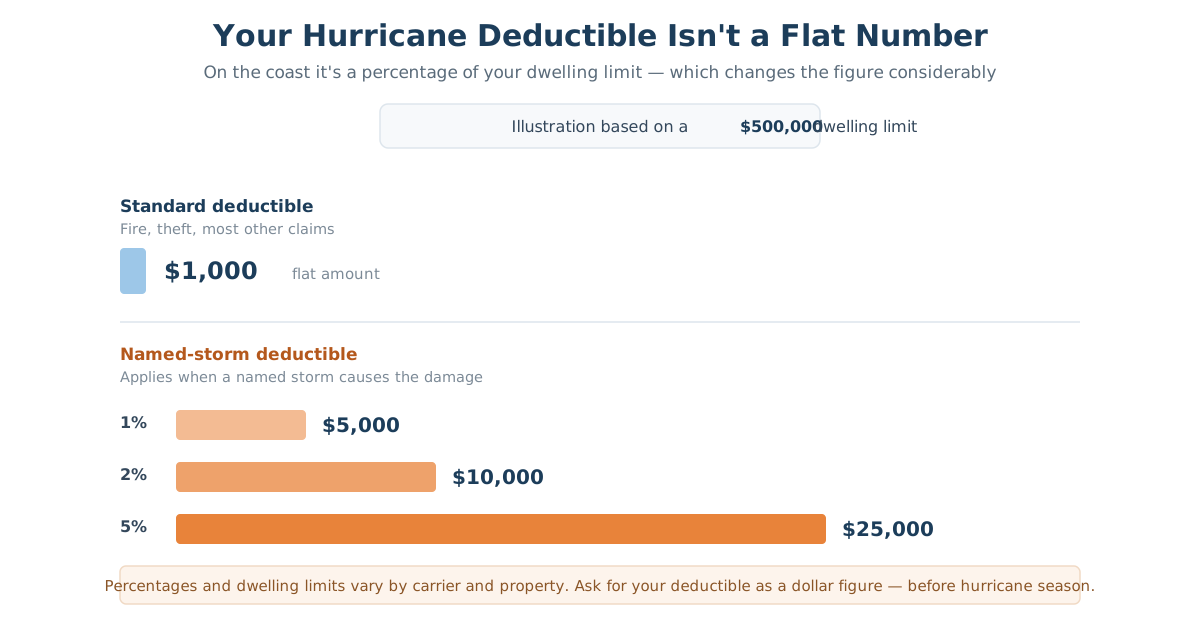
Wind and named-storm deductibles are percentage-based. Instead of a flat $1,000, your hurricane deductible is typically a percentage of your dwelling limit — which on a coastal home is a meaningfully large number. This is the single most common surprise for people moving from inland states. Know your deductible as a dollar figure, not a percentage.
Flood is a separate policy. Always. Homeowners insurance does not cover flood anywhere, but on the coast it stops being theoretical. Properties outside high-risk zones still flood from heavy rain, storm surge, and tidal events.
→ Flood and hurricane coverage
Roof age matters more here. Coastal carriers have tightened sharply. A roof that would be unremarkable elsewhere can limit which carriers will write the home at all.
Documentation earns credits. Wind mitigation features — roof-to-wall connections, roof deck attachment, opening protection — reduce premium, but only if they’re documented on an inspection and filed with the carrier.
→ Wind mitigation discounts in South Carolina
Your Auto Insurance Changes Too, and There’s a Deadline
Relocating means new auto coverage, and South Carolina has its own minimum requirements and its own registration timeline. Vehicle registration and licensing carry deadlines after establishing residency, and proof of South Carolina auto coverage is part of that process.
Handle auto alongside home. Bundling frequently prices better, and more importantly it prevents the gap that occurs when someone registers a vehicle before updating coverage.
→ South Carolina auto insurance requirements
If You’re Buying Rather Than Renting
Everything above applies, plus the purchase itself has an insurance timeline. Get an insurability answer during due diligence rather than at closing — it’s free, and occasionally it changes what a buyer is willing to offer.
→ Buying a beach house in South Carolina
If you’re buying a condo, the association’s master policy determines what your own policy has to cover, and that varies enormously by building.
→ Buying a coastal South Carolina condo
If You’re Keeping a Property Where You Came From
Common with relocations, and it changes both policies.
A house you’ve moved out of is no longer owner-occupied. If you’re renting it out, it needs a landlord policy. If it’s sitting empty while it sells, most policies restrict coverage after a defined vacancy period — and that clock starts the day you leave.
→ Renting out your coastal property
A Realistic Timeline
60–90 days out. Identify whether your current carrier writes coastal South Carolina. If not, start looking now rather than during your move.
30 days out. Home coverage quoted on the actual address. Flood zone determination. If you’re buying, this happens during due diligence instead.
2 weeks out. Coverage selected and bound. Auto coverage arranged to take effect on arrival.
On arrival. Vehicle registration and licensing. Confirm flood coverage is in force and understand any waiting period.
First 90 days. Wind mitigation inspection if the home may qualify for credits. Review whether an umbrella policy makes sense — common for coastal owners, particularly with pools, docks, or a rental property.
Frequently Asked Questions
Can I keep my current insurance company when I move to South Carolina?
Sometimes, but not reliably. National carriers vary widely in coastal appetite, and some decline coastal South Carolina entirely. Treat it as a new placement and confirm early.
Why is coastal South Carolina insurance more expensive?
Hurricane exposure, reinsurance costs, and rebuilding costs across the Southeast. Wind is typically the largest single component of a coastal premium — and the part most affected by documented mitigation features.
Do I need flood insurance if I’m not in a flood zone?
Every property is in a flood zone; some are lower risk. Lenders require coverage in high-risk zones. Outside them it remains a genuine exposure, and coverage is generally less expensive.
What is a hurricane deductible and how is it different?
It’s a separate deductible applying to named-storm damage, calculated as a percentage of your dwelling limit rather than a flat amount. On a coastal home the dollar figure is substantial and worth knowing before hurricane season.
How soon do I need South Carolina auto insurance?
Coverage should be in place when you establish residency and register vehicles. Requirements and deadlines are specific — worth confirming before you arrive rather than after.
I’m moving here but keeping my house up north. What happens to that policy?
It changes. Once you no longer occupy it, it isn’t a homeowners risk. Renting requires a landlord policy; leaving it vacant triggers vacancy restrictions on most policies. Tell both carriers what’s actually happening.
We Do This Regularly
Coastal Insurance Brokers is an independent agency with offices in Mount Pleasant and North Myrtle Beach. We compare carriers across the standard, high-value, and surplus lines markets, including markets most local agencies cannot access directly.
A significant share of the people we work with are new to South Carolina. Knowing which carriers currently want coastal property — and which have pulled back — is the practical difference between a placement and a series of declines.
John Cosgrove, Owner & Principal Insurance Advisor
Licensed South Carolina Property & Casualty Agent, License #446274
South Carolina Surplus Lines Broker
→ Meet our licensed agents
Reviewed August 1, 2026 · Serving coastal South Carolina
Part of our guide to owning coastal property in South Carolina.
Moving to the Coast? Start Before You Arrive.
Tell us where you’re moving and what you carry now. We’ll tell you whether your current carrier writes coastal South Carolina, what will look different, and what to have handled before you get here.
No cost, no obligation.
Call (843) 471-2621 · Text (843) 834-6408