
Your renewal arrived, and the number went up again.
If you own a home in Mount Pleasant, Charleston, or anywhere along the South Carolina coast, you already know the pattern. Coastal Charleston-area homeowners pay some of the highest premiums in the state — well above what the same house would cost to insure in Columbia — and the increases haven't stopped. Carriers have tightened their appetite for coastal property. Some have non-renewed entire categories of homes. Reinsurance costs, rebuilding costs, and storm losses across the Southeast all flow downhill into your renewal notice.
Here's what most homeowners don't know: for many coastal homeowners, the wind portion represents the largest share of the premium. It's the biggest thing you're paying for. It's also the one part of your premium you can actually do something about — not by shopping harder, not by gutting your coverage, but by documenting what your house already is, and upgrading what it isn't. (Flood coverage is priced and rated separately — see our guide to how much flood insurance costs in the Charleston area.)
South Carolina insurers offer wind-mitigation discounts for homes with verified protective features. The South Carolina Department of Insurance confirms that both state and national mitigation certifications can make homeowners eligible for insurance discounts, though discounts vary by carrier. In our own experience across comparable coastal homes, those discounts have ranged from roughly 10% to 30% of the wind portion of the premium, depending on the carrier — and industry organizations cite savings reaching 35% for certified homes.
The catch — and the reason this guide exists — is that none of it happens automatically. Insurers do not guess in your favor. A credit that isn't documented is a credit that doesn't exist. In our policy reviews, missed mitigation credits are one of the most common — and most fixable — problems we find.
Why Homeowners Trust Coastal Insurance Brokers
✔ Independent agency representing 25+ insurance companies
✔ Serving Charleston, Mount Pleasant & the South Carolina coast since 2010
✔ Licensed South Carolina Property & Casualty advisors
✔ Local expertise in coastal insurance, wind mitigation and flood protection
✔ Personalized policy reviews — not one-size-fits-all quotes
First, What This Is Actually Worth
In our experience across comparable coastal homes, mitigation discounts have commonly ranged from 10% to 30% of the wind portion of the premium, depending on the carrier and the home's documented features.
Because every home, coverage package, deductible, and carrier is different, the actual dollar value varies. That's why reviewing how your own home is rated is more valuable than comparing generic savings examples.
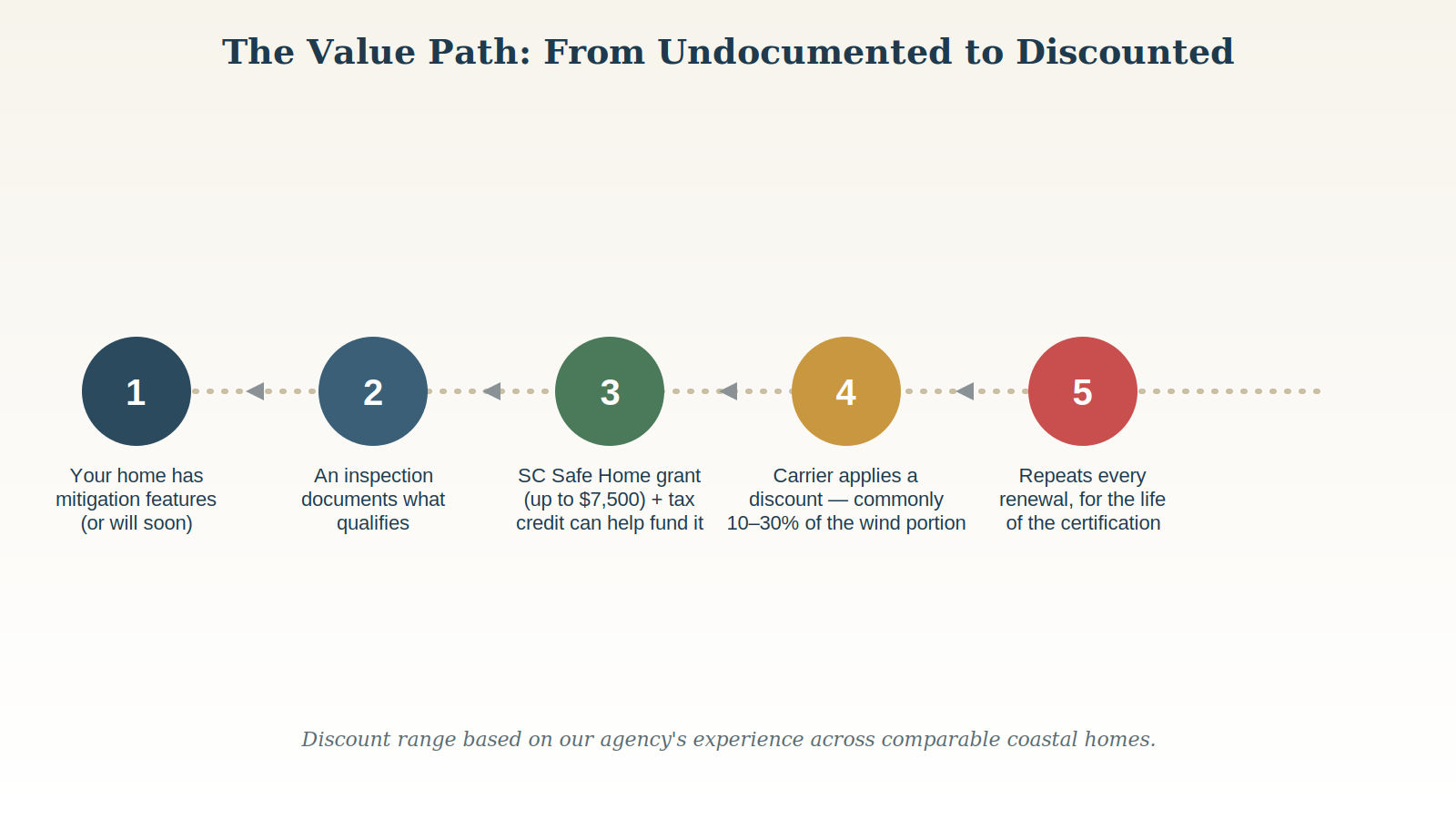
Now layer in the upgrade path for a homeowner whose roof doesn't yet qualify: a FORTIFIED-standard re-roof typically costs modestly more than a standard re-roof when the roof is being replaced anyway; the SC Safe Home grant can contribute thousands toward qualifying work; South Carolina offers a fortification tax credit against state income taxes; and the insurance discount then repeats every year for the life of the certification.
For many coastal homes, the certification pathway is net-positive within a few renewal cycles — and the house is genuinely stronger in the next storm, which is the part your insurance can't buy back after the fact.
What We See Every Week
These aren't hypotheticals. They're the patterns that come up over and over in our policy reviews.
The 1990s Mount Pleasant house with undocumented straps. We see this most often on homes built in the early-to-mid 1990s around Mount Pleasant. The home already has hurricane straps — builders installed them as post-Hugo code enforcement took hold — but nobody ever submitted a wind mitigation inspection to the current carrier. The carrier has been rating the home as if the straps don't exist. One inspection later, the premium drops. The feature was there for thirty years. The discount wasn't.
The new roof that earned nothing. Homeowners spend thousands replacing a roof — good materials, licensed contractor, real money — but FORTIFIED never comes up until after the job is complete. By then, the opportunity for certification and the best insurance discounts may already be gone. The most expensive part of a FORTIFIED roof is finding out about it after the contractor leaves. (More on this in our guide to roof age and home insurance.)
The right features on the wrong carrier. This is probably the biggest advantage of being independent: two carriers can look at the exact same house and value its mitigation features very differently. Same home, same straps, same sealed deck — materially different premium. The difference was never the house.
The Wind Pool exit nobody attempted. We've seen homeowners remain in the SC Wind Pool for years simply because nobody ever re-marketed the policy after improvements were made. After a retrofit, the standard market will often take a home it once declined — usually with broader coverage.
The Discounts Hiding in Your Attic
When carriers price wind coverage on a coastal home, they're pricing the probability that your roof stays attached in a major storm. Homes with features that demonstrably reduce wind losses get priced accordingly — but only if those features are documented.
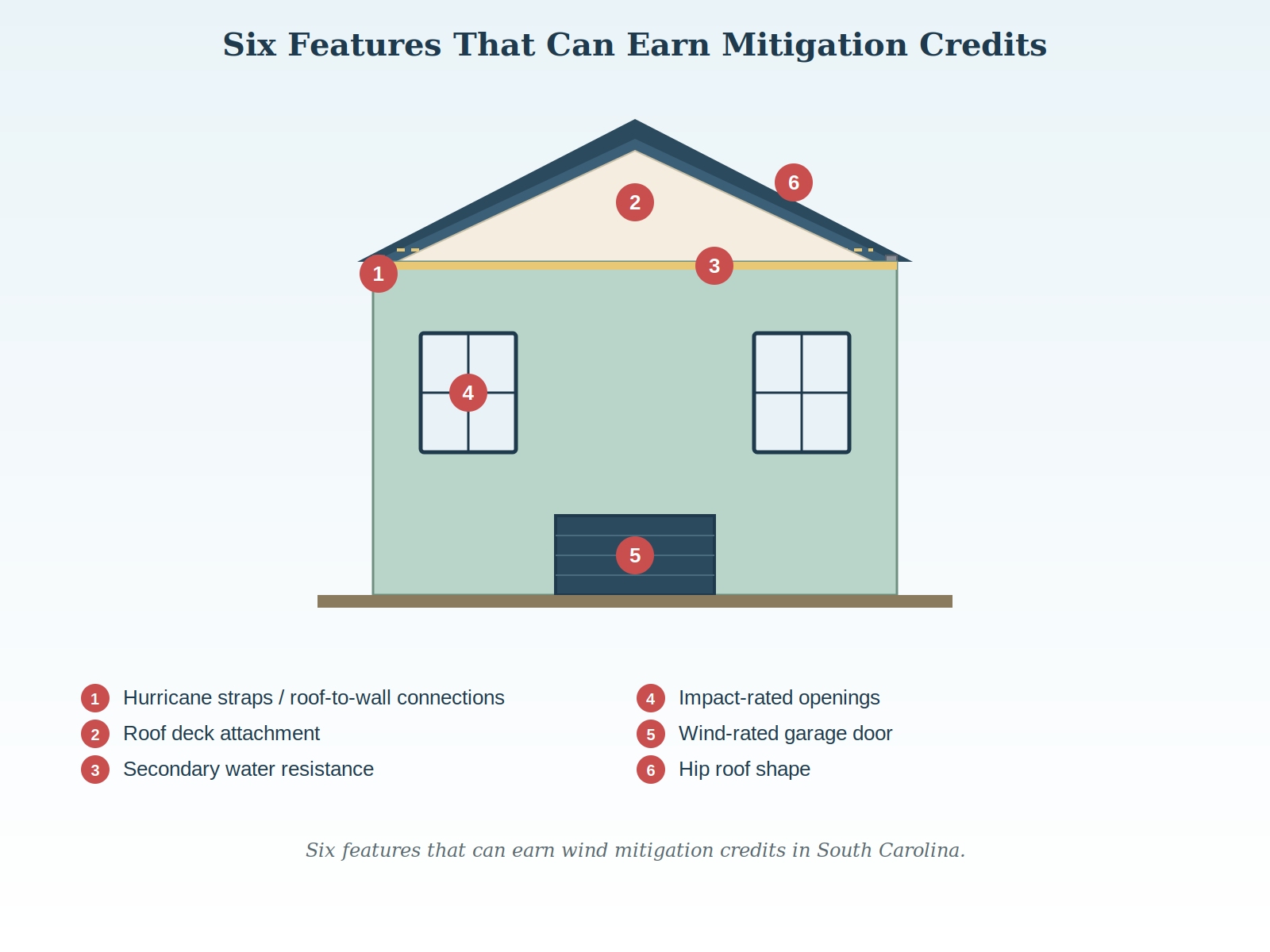
The features that most commonly earn consideration in South Carolina:
Roof-to-wall connections (hurricane straps or clips). Metal connectors that tie the roof structure to the walls. In our experience, this is one of the two features carriers disagree about most when rating a home — which means it's also where an independent comparison finds the most money. Many Charleston-area homes built after Hugo already have them; if they were never documented, you may be paying as though they don't exist.
Roof deck attachment. How the plywood or OSB decking is fastened to the trusses. This is the other feature we see carriers weight most differently. Closer nail spacing and ring-shank nails earn better ratings.
Secondary water resistance (SWR). A sealed roof deck that keeps water out even if shingles blow off. Common on newer construction and FORTIFIED retrofits.
Opening protection. Impact-rated or code-approved protection for windows, doors, and garage doors. On some policies these reduce the premium and eliminate separate shutter requirements.
Rated garage doors. A failed garage door is one of the most common starting points for catastrophic wind damage — a wind-rated door is both a discount opportunity and genuinely one of the best dollar-for-dollar protections a coastal home can have.
Roof shape and covering. Hip roofs typically rate better than gable roofs; newer roofs with high-wind-rated coverings rate better than aging ones.
FORTIFIED and SC Safe Home: The Two Certifications That Matter
South Carolina recognizes two closely related certification pathways, both built on the same nationally recognized mitigation standards:
SC Safe Home certification — the state's designation, administered by the South Carolina Department of Insurance. One distinction: the Safe Home standard requires roof-to-wall connectors.
IBHS FORTIFIED Roof™ certification — the national designation from the Insurance Institute for Business & Home Safety, which includes third-party evaluation of the work.
The construction standards are nearly identical, and many homeowners pursue both during the same roof project — the SCDOI notes that dual-standard "Resilient Mitigation" projects may offer additional insurance-related benefits. Either certification can make a homeowner eligible for carrier discounts, and because those discounts genuinely vary by carrier, which certification is worth more depends on who's insuring you — a question an independent agency can answer across many carriers at once.
The SC Safe Home Grant: Real Money Toward Qualifying Upgrades
If your home doesn't yet have these features, South Carolina will help pay for them. The SC Safe Home Mitigation Grant Program — created by the Omnibus Coastal Property Insurance Reform Act of 2007 and administered by the SC Department of Insurance — provides grants, not loans, to coastal homeowners for wind-mitigation retrofits.
Current award tiers (per SCDOI):
| Project Type | Non-Matching Grant | Matching Grant |
|---|---|---|
| Resilient Mitigation (SC Safe Home + IBHS FORTIFIED dual standard) | Up to $7,500 | Up to $6,000 |
| Sustainable Mitigation (Safe Home standard, or opening protection) | Up to $5,000 | Up to $4,000 |
| Hurricane Shutters / Protective Barriers | Up to $3,000 | Up to $3,000 |
Award amounts are income-based — determined by household adjusted gross income relative to county or state median income figures published by HUD — and the SCDOI provides an online award estimator. Qualifying work includes roof deck attachment, secondary water barriers, high wind-rated roof coverings, gable end bracing, roof-to-wall reinforcement, and impact-rated or code-approved opening protection.
Eligibility essentials every Charleston-area homeowner should know before applying:
- The home must be an owner-occupied, single-family primary residence in a designated coastal county
- You must carry an active homeowners policy
- The home must have no prior storm-related damage or insurance claim payouts — the program funds prevention, not repair
- One grant per home, and grant funds cannot be used for general repairs or remodeling
And the most important practical fact: applications open only during limited windows — twice a year — and funding is finite. Recent cycles have exhausted their funds well before demand did. The SCDOI maintains a notification signup through its application portal; if a retrofit is anywhere in your plans, sign up now and have your documents ready before a window opens. Check the SCDOI SC Safe Home page for current application status.
South Carolina also offers a state fortification tax credit for qualifying mitigation expenses — commonly cited at up to $1,000 or 25% of project cost — which can stack with the grant. Confirm the current credit and your eligibility with a tax professional.
The Part Nobody Else Can Tell You: Carriers Don't Agree About Your House
This is the section that matters most, so we'll be direct about it.
Any national website — or any AI tool — can tell you that hurricane straps exist and that FORTIFIED roofs earn discounts. That information is everywhere, and most of it is accurate as far as it goes.
Here's what it can't tell you, because this knowledge only exists inside the day-to-day work of quoting coastal South Carolina homes across many carriers at once:
Every carrier weights mitigation differently — and we can put numbers on it. Across comparable coastal homes, we've seen mitigation discounts range from roughly 10% to 30% of the wind portion of the premium depending on the carrier. The two features carriers disagree about most, in our experience: hurricane straps and roof deck attachment. There is no public chart of this. It lives in rating plans, underwriting appetites, and the pattern recognition that comes from quoting the same coastal ZIP codes week after week across 25+ companies — national names, coastal specialists, and surplus lines markets standard carriers can't access. When we say "your features may be worth more with a different carrier," that isn't a slogan — it's the single most common way we find money for coastal homeowners.
We know which credits survive underwriting, not just which exist on paper. A discount listed in a brochure and a discount that actually applies to your bound policy are different things. Roof age caps, inspection requirements, photo documentation standards, replacement-cost-vs-ACV triggers — these determine whether the credit you read about becomes the credit you receive.
We know this housing stock. Pre-Hugo construction on James Island. Early-1990s post-Hugo neighborhoods in Mount Pleasant. Elevated new builds in Cainhoy. Barrier-island homes inside Wind Pool Zones 1 and 2 versus mainland homes outside them. The question "does my house qualify for anything?" has a different starting answer depending on which of these describes your home — and we can usually tell from the address and year built before anyone climbs into an attic.
We see the claims side. Mitigation isn't only a discount strategy; it changes what happens to you after a storm. We've seen similar homes come through the same storm with very different outcomes because one had a properly reinforced roof system and the other didn't — the stronger home suffered limited roof damage, while the other experienced significant interior water damage after the roof covering failed. The discount is annual. That difference is everything.
That combination — live carrier-by-carrier rating knowledge, underwriting reality, local building stock, and claims experience — is what an independent local agency actually sells. The quote is just the receipt.
John's Recommendation
If you've been with the same insurance company for several years, it's a good idea to make sure your home is still being rated correctly. We've found many homeowners have improvements or mitigation features that were never documented. A quick review can confirm you're getting every credit you deserve — or show you where you're leaving money on the table.
— John Cosgrove, Owner & Principal Insurance Advisor
Your Next Step, in Three Questions
1. Was your home built after 1989?
Post-Hugo code enforcement means many Charleston-area homes from the early 1990s onward have creditable features by default. → Likely action: verify what's documented with your current carrier. This is the "found money" scenario.
2. Is your roof due for replacement in the next 1–4 years?
This is the golden window. The incremental cost of building to the FORTIFIED standard is lowest when the roof is coming off anyway, and the SC Safe Home grant can fund qualifying work — but applications must be approved before work begins, and only undamaged homes qualify. → Likely action: sign up for the SCDOI portal notification list and get grant-ready now.
3. Has anything changed since your policy was written — new roof, new windows, new garage door, retrofit, or just years passed?
Policies rate the house the carrier knew about on day one. Improvements that were never reported earn nothing. → Likely action: a policy review to reconcile the house you own with the house you're rated as.
If you answered yes to any of the three, there's a realistic chance you're leaving money on the table.
| If... | Then... |
|---|---|
| Home built after 1989 | Verify mitigation documentation with your carrier |
| Roof replacement planned | Explore FORTIFIED and SC Safe Home before signing the contract |
| Home improvements made | Update your carrier — undocumented upgrades earn nothing |
| Unsure about discounts | Schedule a policy review |
The 60-Second Self-Check
☐ Do I know what my wind/hurricane deductible costs in dollars, not percent?
☐ Has a wind mitigation inspection ever been submitted to my current carrier?
☐ Do I know whether my roof-to-wall connections are documented?
☐ If I've replaced roof/windows/doors, did my carrier ever hear about it?
☐ Do I know what the same features would be worth with a different carrier?
Two or more empty boxes is the signal.
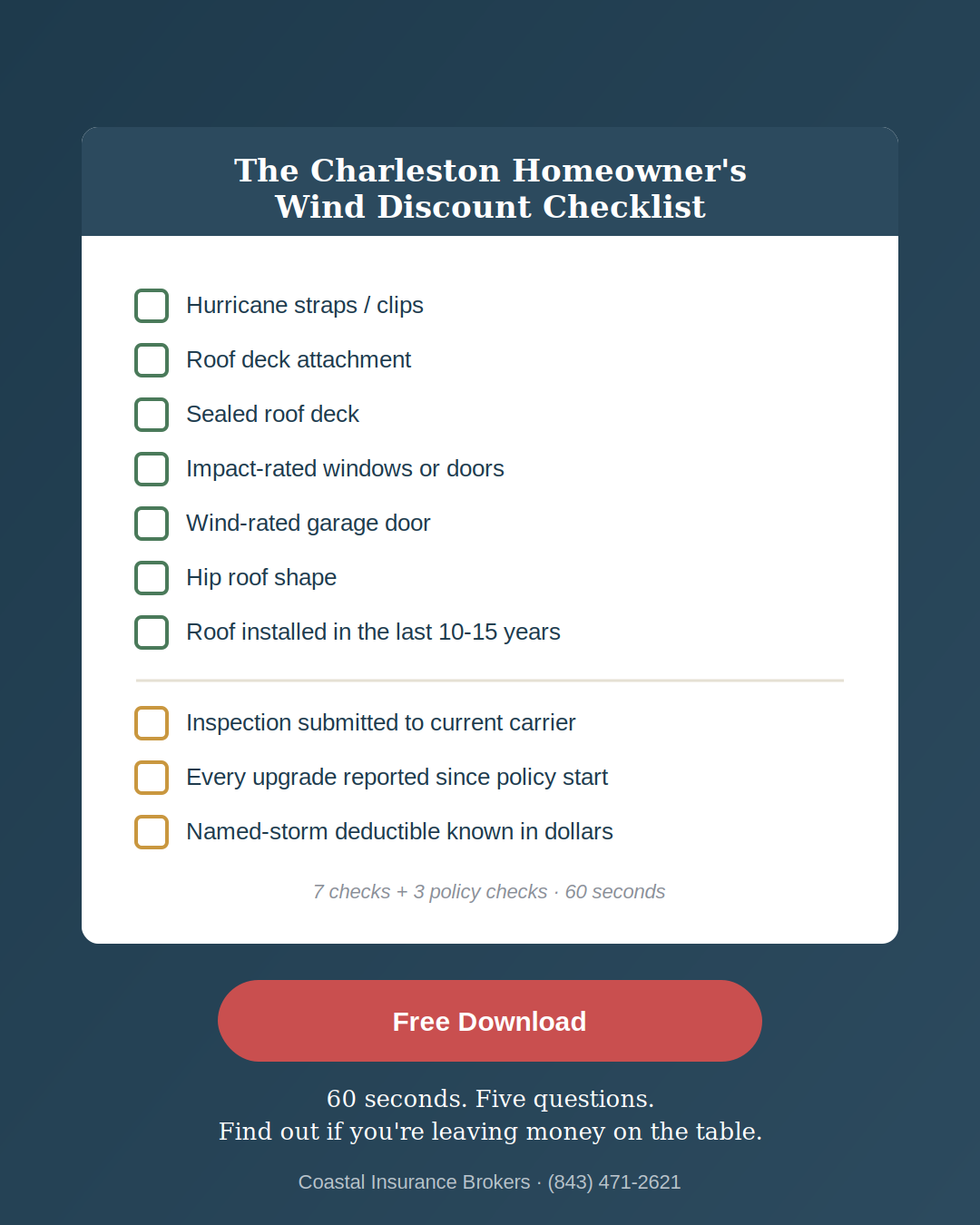
Free Download: The Charleston Homeowner's Wind Discount Checklist
60 seconds. Five questions. Find out if you're leaving money on the table — download the same checklist we use in policy reviews.
Frequently Asked Questions
Do hurricane straps really lower my insurance?
Is the discount on my whole premium or just part of it?
Does a new roof automatically qualify?
I'm in the SC Wind Pool. Does any of this apply to me?
Can I get the SC Safe Home grant after storm damage?
How do I know when grant applications open?
Find Out What Your Home Already Earns
Here's our offer, and it's deliberately not a sales pitch: bring us your current policy, and we'll tell you three things — which mitigation credits are being applied, which ones your home likely qualifies for but isn't receiving, and whether your home's features would be worth more on a different carrier's rating plan.
If everything checks out, you'll know your policy is right, and that's worth knowing. If it doesn't, you'll know exactly what to fix and what it's worth.
Our goal isn't simply to quote another policy. It's to make sure your home is being rated correctly before you spend another dollar.
Written and reviewed by John Cosgrove, Owner & Principal Insurance Advisor, Coastal Insurance Brokers. Licensed SC Property & Casualty Agent #446274; SC surplus lines broker. Serving Mount Pleasant, Charleston, and North Myrtle Beach since 2010. Sources: SC Department of Insurance (SC Safe Home Mitigation Grant Program; Bulletin 2024-02), Insurance Institute for Business & Home Safety. Last updated July 30, 2026
Older homes often qualify for more wind mitigation credits than owners expect. See our guide to home insurance for Old Village, Mount Pleasant, or our full guide to owning coastal property in South Carolina.